Marvels & Surprises for the Curious at Heart

My Photo
Name:
Location: Richmond, VA, United States

Monday, March 30, 2009

Mermaids

The Fiji Mermaid (aka Feejee mermaid)

This artifact was a common slideshow attraction in P.T. Barnum's (yup the circus guy) museum. She was advertised as a gorgeous topless siren, but was actually the mummified corpse of an ape sewn to a fish - a really "grotesque" take on the mermaid and sirens of sea stories.

Here's the Banff Merman!
Mermaids are something that we are still fascinated by. People often mistake sunbathing seals and other animals to be mermaids. And some people even suffer from Mermaid Syndrome (aka sirenomelia) where their legs are fused together to due a rare congenital deformity, like this little girl from Peru.


Remains of mermaids were highly treasured and during the Renaissance, they were often found in cabinets of curiosities.


The Fifi mermaid is now in the attic at Harvard University's Peabody Museum of Archaeology and Ethnology.

Thursday, March 26, 2009

Crystals

I've stumbled across a couple things that just their sheer beauty inspires amazement and awe, even if the core thing is very simple. This is one of those examples of a very simple, and commonplace, natural process becoming an extraordinary wonder.

It's buried a thousand feet under Naica mountain in the Chihuahuan Desert in Mexico...


The Cueva de los Cristales (Cave of Crystals) in Mexico has some of the largest crystals on earth. They are made of gypsum, a soft, translucent mineral that you can scratch with your fingernail. Some of the crystals are as long as 36 feet and as heavy as 55 tons. Each of the columns on the Pantheon in Greece weighs that same amount.


According to scientists, this cave has a very stable environment with temperatures around 136 degrees Fahrenheit. The water in the cave was full of the mineral anhydrite which dissolved into gypsum at high temperatures. These factors helped the crystals grow to amazing heights and lengths.


Of course, my addiction to Planet Earth returns. Maybe it's the science nerd in me but I find some the most beautiful things have been drawn and sculpted by Mother Nature. The lack of desire for fame and money makes these more beautiful than almost any work of art made by people. If you get a chance, check out the caves DVD.
I know some people feel like there is more wonder in seeing things for yourself and the journey or pilgrimmage to those sites is part of the experience... and I totally agree! My trip to Costa Rica last summer almost disappointed me a little bit. I couldn't help but wonder about how I'd react to the totally new environment if I had never seen pictures of it, or seen the tropical animals and plants in zoos and gardens or tasted the food in America already. I almost wished we didn't have the technology to see distant places because the specialness was diluted.
But there are some things in life that you and I will never get the expertise or clearance to ever see. This is one of those things.


Authorities in New Mexico have closed down Lechuguilla Cave to the public. Luckily, before that happened, Planet Earth did an amazing segment on the cave and it's crown jewel, the Chandelier Ballroom, whose beautiful crystals are also made of gypsum.
It's almost entirely pristine, there are only a few species (bacteria) that live there and it's just way too delicate to allow visitors to come through.
The pictures do not do it justice. Really, check out the Planet Earth segment.

Thursday, March 12, 2009

100

I learned about this from my boyfriend who goes to UNCW. The Century Project is an amazing work by Frank Cordelle that is touring the country.


It recently came to UNCW for the second time, when school administrators decided that it needed to be censored and certain photographs-banned.
Image from "The Seahawk" UNCW publication.

Here's a snipet from the project's website: "More than a hundred girls and women of many ages, shapes, sizes, and backgrounds bare all in Frank Cordelle’s The Century Project. The project combines unconventionally stunning nude portraits with highly personal written statements describing instances of rape, debilitating illness, disfiguring surgeries, distorted social expectations, as well as reflections of humor and joy."
The pictures are beautiful and painful and the stories even more so. When it comes to wonder, I think these photos and stories are awe-inspiring. If you define the feeling of wonder as being changed after the experience, this is it. If you have tissues handy, check out the website that's linked at the top of the page "The Century Project."

Sunday, March 1, 2009

We Are Family

To make a long story short, I started off missing someone, googled "cloning," clicked on a pro-life "monument," and ended at this.


These images are from the We Are Family : Still Life with Stem Cells exhibit by Patricia Piccinini
I am crazy about the detail in these sculptures. Every different part of this I look at I see a totally different creature. It's not frightening, it's almost like looking in a kaleidoscope, every time you turn it, you see something new.
Sweet.
I'm not sure if I'm supposed to be grossed out, but I am amazed.
I really can't say much else. These pictures speak for themselves.

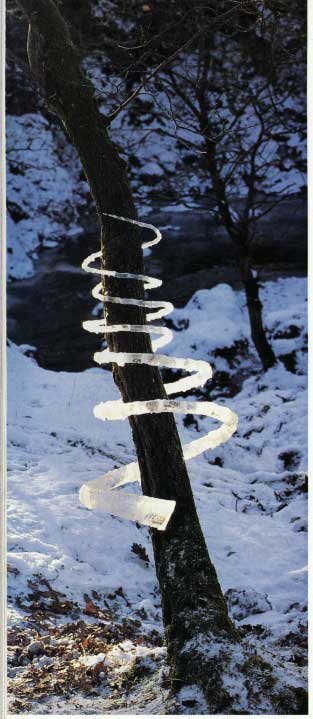
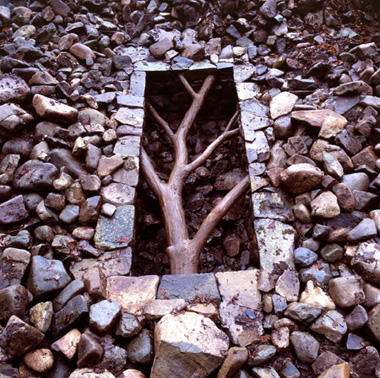
Twigs, Rocks, Ice, Leaves

So I learned about this artist in another Honors class I took about Earth Art.

"I enjoy the freedom of just using my hands and "found" tools--a sharp stone, the quill of a feather, thorns. I take the opportunities each day offers: if it is snowing, I work with snow, at leaf-fall it will be with leaves; a blown-over tree becomes a source of twigs and branches. I stop at a place or pick up a material because I feel that there is something to be discovered. Here is where I can learn. "


"Looking, touching, material, place and form are all inseparable from the resulting work. It is difficult to say where one stops and another begins. The energy and space around a material are as important as the energy and space within. The weather--rain, sun, snow, hail, mist, calm--is that external space made visible. When I touch a rock, I am touching and working the space around it. It is not independent of its surroundings, and the way it sits tells how it came to be there."


"I want to get under the surface. When I work with a leaf, rock, stick, it is not just that material in itself, it is an opening into the processes of life within and around it. When I leave it, these processes continue."


"Movement, change, light, growth and decay are the lifeblood of nature, the energies that I try to tap through my work. I need the shock of touch, the resistance of place, materials and weather, the earth as my source. Nature is in a state of change and that change is the key to understanding. I want my art to be sensitive and alert to changes in material, season and weather. Each work grows, stays, decays. Process and decay are implicit. Transience in my work reflects what I find in nature."


"The underlying tension of a lot of my art is to try and look through the surface appearance of things. Inevitably, one way of getting beneath the surface is to introduce a hole, a window into what lies below."


I would have to put Andy Goldsworthy in the very short list of artists that I like. Although I don't feel like I understand what he's trying to say, just seeing nature as the inspiration and material for art makes me like it. The best part about his work is that it's not permanent. It's not about taking up space on a museum wall with the burden of existence for a painted canvas. His works make me think of memories: the struggle to remember a dream in the first foggy moments of waking up when you try and tie, weave, lock, stack, lay, place, wrap bits and pieces together. And for a minute, maybe longer, you have the idea. But it won't last.
I think the wonderful thing about his art is how he sees shapes in nature. What's amazing is that he can create them.